Hundred Highways Tour #42, #43: I-90 & US 2 to the GetLit! Festival

DSCN1667A short jump from Coeur d’Alene to Spokane for the GetLit! Fest. Too much free wine, too nice of a hotel and a fantastic downtown/park. Mostly I walked around being surprised by how nice of a city this is. I’d only visited once before, and that was just to fill a U-Haul truck with boxes of my cousin Doug Peacock‘s book, Walking It Off. The press that published it was getting the axe, so we bought up all their stock. I was in town only long enough to load up.

So it was great to be able to spend a few days and realize how much this city has going on. After my reading at the festival, sharing a stage with a fantastic memoirist, Julie Riddle, who’s book The Solace of Stones is a powerfully honest look at childhood, wilderness and the endless paradox of Montana, someone asked me if I’d been to the waterfall yet. I had seen signs for it in the park and for some reason pictured a small run of whitewater cascading over rocks, maybe a couple dozens yards worth of drop — pretty, but not a huge priority.

Why that was my assumption, I have no idea. I’d forgotten the importance of remaining open to everything while on the road (0r anywhere for that matter). But, if someone says, “you should go see this,” it’s important to remember the words of Kurt Vonnegut: “Peculiar travel suggestions are dancing lessons from God.”

DSCN1697[Read more reports from the Hundred Highways Tour here.]

Posted in Hundred Highways, Writing | Tagged , , , , , | 1 Comment

Hundred Highways Tour #37 – 41: US 93, MT 200, MT Secondary 471, NF 9, I-90 to The Well-Read Moose

photo by Lisa Beaudin

photo by Lisa Beaudin

Since my reading the night before at Fact & Fiction was followed by some serious bar-hopping and it being pointed out to me that at midnight, it officially became my birthday, we ended up get a late start to head to Coeur d’Alene for a gig at The Well-Read Moose. But we still were able to take back roads. Cutting north on 93 passing near the Garden of One-thousand Buddhas at Arlee and passing numerous road signs in Salish and Kootenai languages. The languages use characters and symbols far beyond my word processing skills, but their English translations are fantastic: “Place Where You Surround Something” and “Little Valley Behind Hills.”

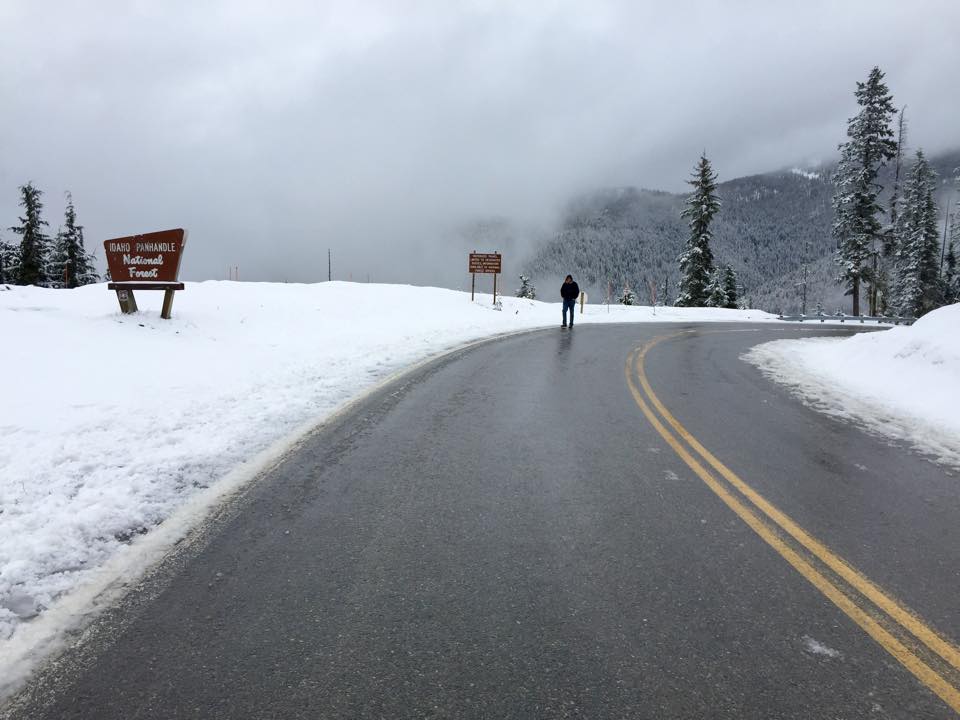
After a road drink in Thompson Falls, we crossed a mountain pass that threw us back into winter. The Midwesterner in me still has trouble fathoming severe snow and ice conditions in April, but we got lucky and were able to make it through, dropping into Idaho, and eventually into “Heart of the Awl.” Rather than try to tell you about the drive, here’s my birthday poem for this year that I finished a day later in a Spokane bar:

Birthday Poem, 2016

Let’s begin the day
listening to Brahms in a Missoula hotel room
then the drive
along the spring roiling of the Flathead River
with tongues of fog lolling up from mouths of fir trees
to taste the sky

Let’s stop at a bar in Thompson Falls
empty but for a daytime card game
of somebodies’ grandmothers
to have a pint & find out if the pass is open–
snow & rain & elk & a wild turkey
at the roadside like a desolate hitchhiker–
but drivable if we take it slow

& the confusion of west-flowing rivers
in place of my habitual eastbound ones

Yesterday, a coyote on the median
testing the limits of mortality
& the physics of steel,
Tomorrow, a dark corner bar in Spokane
with bad music & too many TVs
But today,
as soaring as the Brahms
as delicate as the fog,
to be here with the woman I love
with bellies full of sushi
& the lights of Coeur d’Alene seeping
through the blinds &
painting our bodies in joy

[Read more reports from the Hundred Highways Tour here.]

Posted in Hundred Highways, Writing | Tagged , , , , , , , , , , | 1 Comment

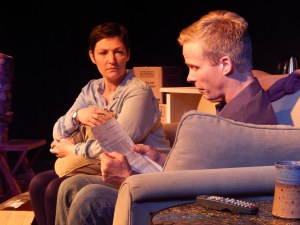
Dying City

Dying City by Christopher Shinn
Caldera Theatre Company, 2016
Directed and designed by Marc Beaudin

Click image for full photo gallery.

Click image for full photo gallery.

Director’s Note from the program:

For us at the CTC, theatre as an artform doesn’t happen on the stage or in the actors’ imaginations. Rather it exists in the moment of communication between us and you. In the connection between actor and audience – the two coming together to create the reality of a moment, art happens. Television has viewers, sports events have spectators, but the theatre has participants. By choosing to accept our offer to come together in a certain place and time, to add your imaginations, memories, emotions and dreams to the cauldron, together we brew something magical, rare and beautiful: Truth.

In this play, the truth of these characters’ lives is evasive. It flashes in unexpected places, it fails to reside where we expect it to, it slips from our grasp when we most think we have hold of it. Mostly, it swims deep below the surface of what is spoken.

Kelly’s truth collides with that of Peter, her deceased husband’s twin. In flashback scenes, it’s Kelly and Craig’s truths that collide. All these truths are at odds with those of unseen (but heavily felt) parents, lovers, co-workers and patients – as well as the great (un)truth of the Iraq War.

But there is another truth at play here: the truth of being fully aware, in the moment. That’s what we seek, with your help, to create. What we find in that moment might be painful, it might be funny or difficult or confusing or upsetting or inspiring – but this is why we have theatre. To ask questions that may confound us, to explore the darkness because, paradoxically, that’s where the light is to be found. As Socrates reminds us, “the unexamined life is not worth living.”

Thank you for joining in our examination and for making the life of this moment worth the living.

A note on the set design:

The world of these characters, defined by the floor rug and the lighting, hovers within the void. Beyond Kelly’s apartment is darkness: the dark unknown of war, failed love, the past, the future – the door to the outside world. Memories, hopes and fears emerge from the void and return to it. Kelly and Peter are surrounded by it, compelled by it, but powerless against it. Craig is both of it and not of it. The only thing on the set that rests in the void but connects into the apartment is the television – offering a relationship to the world beyond the void. But is it a true offer, or just another lie? Is it connection or anethesia?

Posted in Directing, Set Design | Tagged , , , , , | 3 Comments