Hallelujah Revisited

I remember vividly the first time I heard Leonard Cohen. It was in my room at Squatemala, an anarchist compound of Victorian mansions and carriage houses built by long-dead lumber barons. Over the decades, it had gone feral with broken windows, collapsing walls, leaking roofs and beautiful ghosts roaming the creaking hallways. The overgrown yard, a full-city-block, was hidden by a stockade fence and a row of garage workshops. We added a large wall tent, cultivated wild edibles and gathered nightly around a bonfire for song and smoke, drink and dance.

I had a room in the “Big House,” with moonlight that slipped through leaded glass and a museum of frayed and faded antique furniture.

A very dear friend, a lover then, was surprised and excited that I’d never heard of Cohen. She played “Suzanne” and we lay there, silenced. As a love song, it was instantly among the best I’d heard. Up there with Coltrane’s “Naima” and “San Diego Serenade” by Tom Waits. But then there came this verse:

And Jesus was a sailor when he walked upon the water
And he spent a long time watching from his lonely wooden tower
And when he knew for certain only drowning men could see him
He said all men will be sailors then until the sea shall free them
But he himself was broken, long before the sky would open
Forsaken, almost human, he sank beneath your wisdom like a stone

and I knew I was listening to a poet. I think a poet is someone who says something utterly new that is so true, so authentic to the music of the universe, that the moment you hear the words they seem to have always existed—part of the bedrock, rooted in our pre-conscious myth. Academics, theologians and philosophers could spend years analyzing and explicating these lines. As humans, though, we feel their meaning in an instant.

The song ended, and we played it again. And then we didn’t play it, and it kept playing within.

Sometime later, our friend, the insanely talented artist and musician Jim Perkins started playing a weekly gig at the Hamilton St. Pub, and during his set would play Cohen’s “Hallelujah.” There was a group of us, based around Squatemala and around the Red Eye Coffeehouse—the greatest coffee spot to ever exist—that were there every week. (Of course, you, I hope, have the same independent, quirky designation in your home town—the greatest coffeehouse exists all over the world, and it never sports a green mermaid in its logo.)

The night was always fantastic. Love and camaraderie and silliness and tiny dancers and enough booze to stun a rhinoceros. But then, near the end of the night, Perkins would give in to our screaming request and play “our song.”

I’ve heard there was a secret chord
That David played and it pleased the Lord
But you don’t really care for music, do ya?

And suddenly all of us were on the dance floor, in one big hugging circle, signing as if our lives depended on it. We loved each other, we loved the perfection of the song, we even loved that damn curmudgeon Perkins who was humoring us, and we loved the moment that we pretended would last forever.

But it didn’t.

We moved on. We moved away. Some of us loved each other too much and don’t anymore. Some of us sometimes lay awake remembering those days when something magical and beautiful took hold of us, brought us together and gave us a memory that no one on the outside will ever understand.

But all of us still love Leonard Cohen for giving the us his words, his voice and his pain. And I still love all those people, even the ones I pretend I don’t.
Posted in music review, Writing | Tagged , , , , | Leave a comment

Hundred Highways Tour #48, 49: M-13, M-84 to Bemo’s Bar

Sitting with the Northwoods Improvisors (Mike Johnston on bass)

Sitting in with the Northwoods Improvisers (Mike Johnston on bass)

No tour would be complete without a visit to my birthplace of Bay City, Michigan, and a reading at Bemo’s, my favorite Bay City bar (now that the Old Bar is long gone).

The show was fantastic thanks in large part to the amazing crowd of family and friends who came out for it. Also, having my brother/comrade Todd Berner open for me was perfect. He’s a hell of a songwriter and sounded great. Later, his set with Alyssa Diaz held the room in awe.

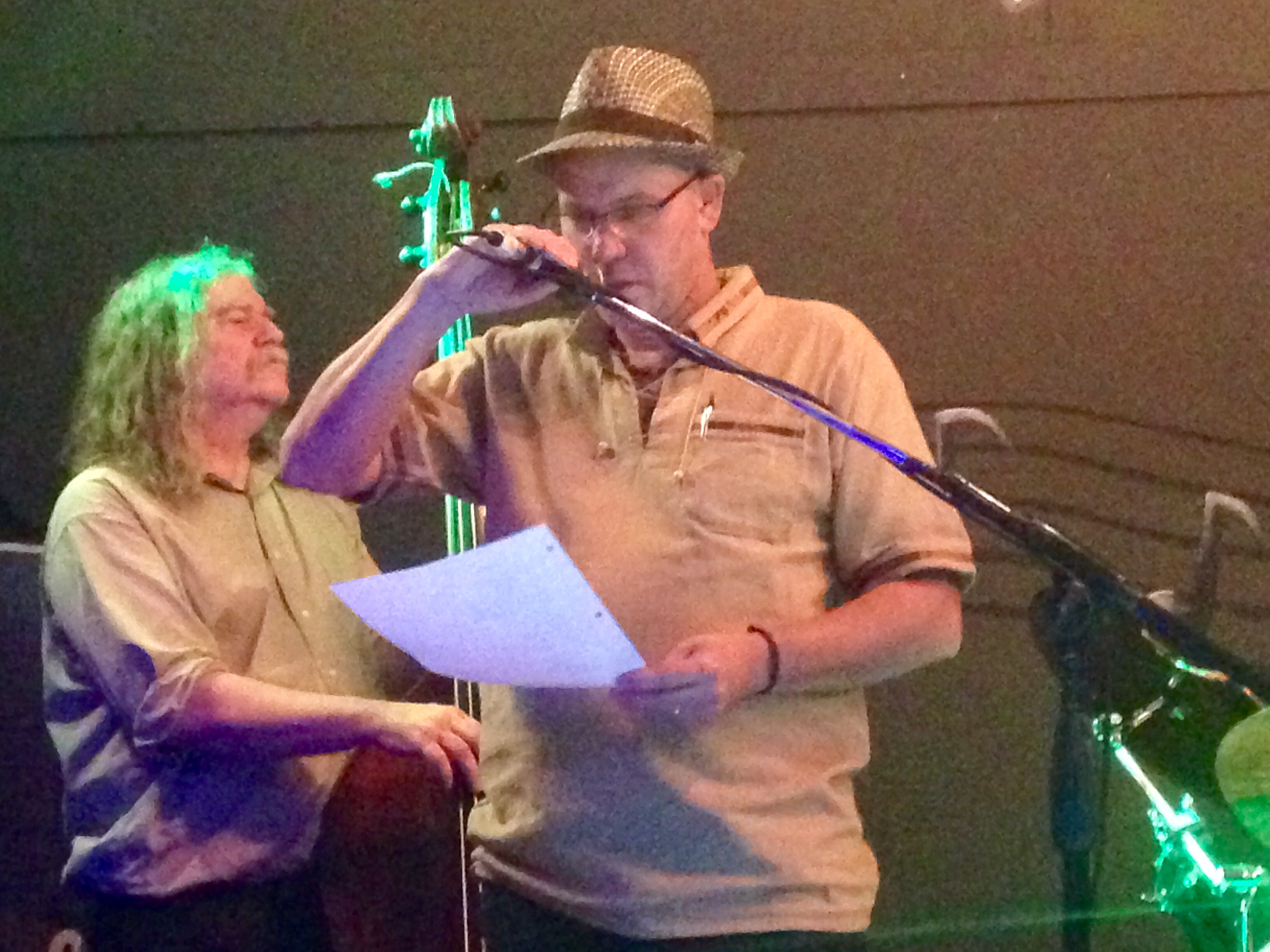
The absolute highlight of the evening (or maybe the entire tour so far) was sitting in during Northwoods Improvisors’ set. This trio of mind and soul-bending artists: Mike Gilmore (vibraphones, marimba, cheng, guitar, saz, percussion), Mike Johnston (bass, wood flutes, percussion) and Nick Ashton (drums, percussion), inspire me like no other living musicians do. It was an honor to be able to introduce their music to some new people, and then to share a new poem while they played an Alice Coltrane piece — wow!
The poem is from a new project I hope to record called From Coltrane to Coal Train: An Eco-Jazz Suite. Here’s the piece we debuted:

Communion

“All a musician can do
is to get closer to the sources of nature,
and so feel that he is in communion
with the natural laws.”
– John Coltrane
spoke these words, 1962
the same year a German coal mine explodes
killing 299 and John Glenn orbits the earth
dancing through “fireflies” of ice
the Centralia coal mine fire begins to burn
decimating two towns & likely to continue
burning for 250 more years and Bob Dylan
first sings “A Hard Rain’s a-Gonna Fall”
& 50 years later
I sit outside this bar
in a brief respite between coal trains
listening to the sparrows
discuss a coming storm
the willow across the road
dances out the same message
the aspens of the courtyard
sigh their thirst,
soon to be slated

I’d like to go in for another beer
But the earth’s music is too compelling

All any of us can do
(as the first rain drops fall)
is to get closer to the sources of nature
(as the birds fall silent)
& so feel we are in communion
w/ the natural laws
(even though what I first take for thunder
is instead the next train
rounding the bend)

[More reports from the Hundred Highways Tour here]

Posted in Hundred Highways, Writing | Tagged , , , , , , | 1 Comment

Hundred Highways Tour #44 – 47: M-25, I-75, I-23, M-14 to Bookbound

When I was in college at a small school in a mid-Michigan cornfield, my best friend was at the University of Michigan in Ann Arbor. I was the poor kid who wanted to transfer there, but knew I could never afford it. It was my Christminster (if that’s not too obscure (hint-hint) of a reference).

Ann Arbor was where I got hipped to social and political activism in the form of the anti-apartheid movement, to the overwhelming amount of what there was to possibly learn in the form of the endless stacks at the graduate library, to the wonders of mind-expanding substances in the form of a little baggie of Pinconning Paralyzer in Mary Markley Hall. It was also where I discovered and fell in love with independent bookstores.

Places like Shaman Drum, West Side Bookshop, Wooden Spoon Books, Crazy Wisdom, David’s Books, and the original Borders — before they sold to K-Mart and the corporate suits did what they always do to a cultural institution. (Sadly, the stores I just listed that don’t have links are no longer with us).

On this visit, nearly 30 years after those days, I had the great pleasure to read at a new Ann Arbor bookstore, Bookbound. The owner’s Peter and Megan Blackshear were fantastically welcoming and friendly. The crowd was small, but a chance to reunite with some great old friends – one of whom, Monica Rico, was one of the Saginista poets of the Red Eye poetry scene back in Saginaw (read her work!), another was my friend Kevin from the pow-wow circuit days who was with me at the beginning and end of several of the road trips in Vagabond Song.

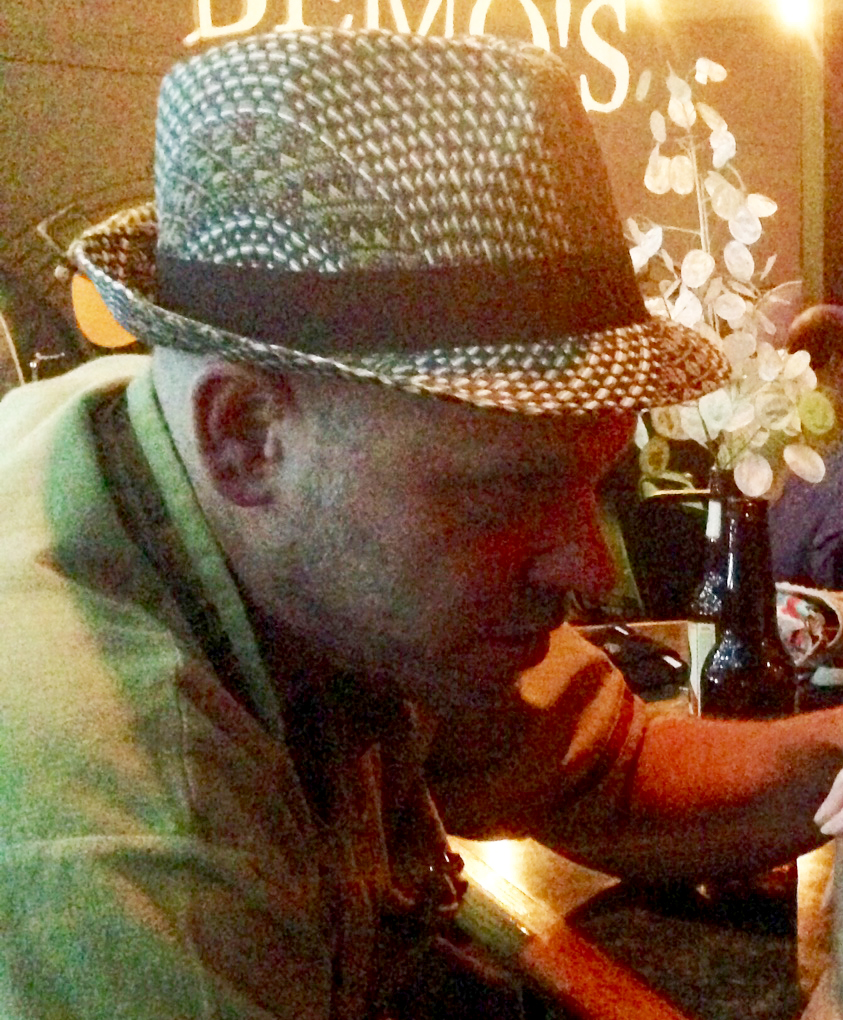
After the reading, there were drinks and more drinks with great friends (Good Ol’ Nats), new and old. The next day, I visited some of the other bookstores in town and kicked around the art fair, where I bought a new hat. Just in time to wear for my next reading, that night at Bemo’s Bar in Bay City (the subject of the next report from the Hundred Highways Tour).

newhat

Posted in Hundred Highways, Writing | Tagged , , , , , , , , , | 1 Comment