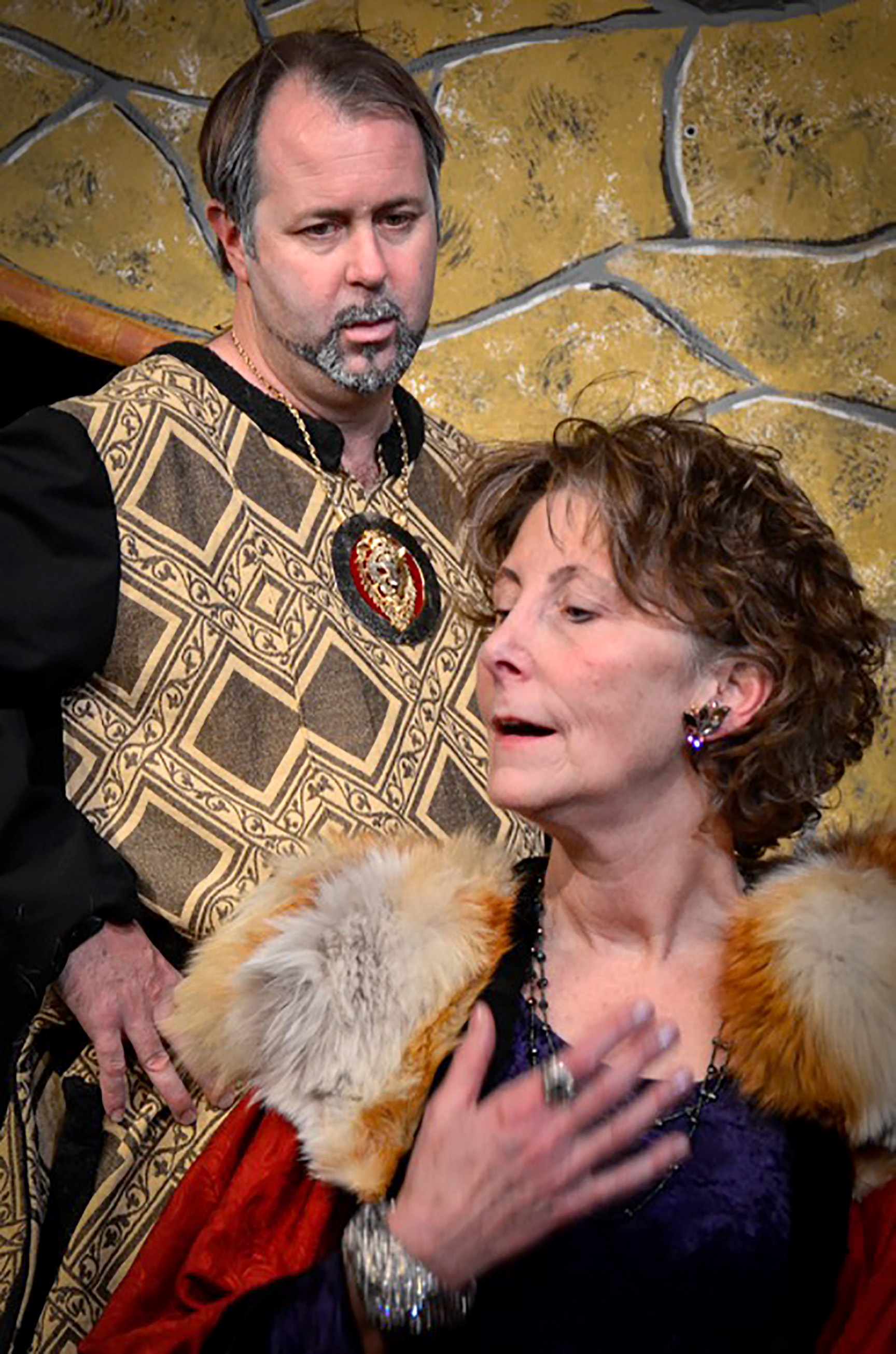
Dracula

Dracula by Steven Dietz
Blue Slipper Theatre, 2010
Directed and designed by Marc Beaudin

Dracula by Steven Dietz. Direction, design and lighting by Marc Beaudin.


Director’s Note from the Program:

Like Count Dracula himself, the appeal of the Vampire legend seems to be immortal.  Ever since Bram Stoker popularized the eastern European myth with his 1897 novel, we’ve been fascinated by the mysterious stranger who comes in the night.  Each new generation adds its own twist on the motif, and each generation is again mesmerized by the Vampire’s spell.

I think the enduring quality of this myth lies in the gifts that the Vampire offers.  Unlike most monsters and creatures of the night, who merely want to kill and eat us, Dracula brings the boons of immortality, power and sexual abandon – the very things that many of us seek or yearn for through the avenues of religion, money, and lewd entertainment.  But unlike those opiates that make seldom-kept promises, the Vampire fulfills his commitment to us with a sensual bite to the neck.  Yet, the cost is the same: our soul.

This play, true to Stoker’s novel, takes us into the heart of this myth, exploring the complexities and contradictions of good and evil, as well as raising complex questions:  Does society teach morality or demand repression of our natural selves?  Does Dracula, as society’s opposite offer depravity or freedom?  Like all great art, Dietz’s play doesn’t give the answers.  Rather it holds up a mirror and forces us to search for those answers within ourselves.  Hopefully, what we see reflected in that mirror (if anything) doesn’t terrify us … too much.

Posted in Directing, Set Design, Theatre | Tagged , , , , , | 3 Comments

Lion in Winter

The Lion in Winter by James Goldman
Blue Slipper Theatre, 2012
Directed and designed by Marc Beaudin

The Lion in Winter by James Goldman. Direction, design and lighting by Marc Beaudin.


Director’s Note from the Program:

“As above, so below” goes the Hermetic axiom.

In our play, this is expressed with the line “We are the world in small. A nation is a human thing: it does what we do, for our reasons.”

For me, this gets at the heart of what you will see tonight. On the surface, nation clashes with nation, king with queen, prince with prince; but that’s merely the surface. Deeper down, we find a family that has devolved from very auspicious beginnings to a Christmas that could not be more fraught with strife. We find people who, beneath the plotting and scheming, deceit and rage, are filled with love and the need to be loved. Unfortunately, like far too many modern families, the lines of communication have become, little by little, so twisted and tangled that any attempt to connect fails. Paradoxically, love that can’t be expressed, that must be buried and scorned, mutates into a grotesque: it becomes a severe kind of hate that only exists between people who love each other.

That’s the tragedy of this play. There are so many moments when the needed healing could come in; if only the characters could resist the game that hides their true feelings. Of course, it’s also within the playing of this game that great humor resides, without which the play, as with real life, would be unbearable.

So although this play consists of historical figures from the Middle Ages, this play is really about timeless emotions and needs. Thus the anachronisms both in the script and design. If we see this as a period piece or a history pageant, we miss the point. It’s about people we know, maybe ourselves, who find themselves trapped in emotional prisons of their own making. Yet, there is always the hope that they can break through the dungeon walls. As the above quoted line continues, “Surely, if we’re civilized, it must be possible to put the knives away.”

And our axiom goes both ways: Great changes of state, affecting the lives of millions, hinge on the personal relationships of individuals. Mass groups of people interact with other masses in the same ways that family members do. Despite all the strife and anger and horrible acts, despite the divisions of nations, races and cultures that keep our world at war, the truth is we are all one single family needing to connect. As below, so above.

A Note on the Set Design:

Two things inspired the design for this set. First, descriptions of the actual castle of Chinon where the play takes place, described as being more graceful and delicate than typical architecture of the time. I wanted to capture some of that grace and delicacy, rather than portray a stereotypically “heavy” castle. Second, I made a connection between the idea of lightness and delicacy with the architecture of Antoni Gaudí – his use of organic, flowing forms, specifically his Puerta de la Finca Miralles.

Adding to this basic concept was the feeling of the disjointed and fractured state of the characters. Every way a family should fit together is, for one reason or another, broken in this family. This fracturing is reflected in the set.
Posted in Directing, Set Design, Theatre | 2 Comments

Keep the Sun in the Son’s “Birthday”

Every December, people start reminding us to “Keep the Christ in Christmas,” which, incidentally, I’d say is a pretty good idea. If it means curbing the annual orgy of materialistic spending – flooding corporate chain mega-stores to snatch up every last piece of plastic crap made in Chinese sweat-shops by 9-year old kids because the altar of television has indoctrinated the masses to believe that this gizmo or that gadget is the essential item to prove their love for their children, show their own self-worth, and find true happiness and sex appeal, then I’d say, yeah, bring on the bearded transient who drove the money-changers from the temple (not to mention the whole “water into wine” thing).

However, I’d like to take a moment to urge us all to remember another and much older tradition. Feel free to keep the Christ in Christmas, but allow me to keep the Sun in the Son’s Day.

Christmas is, in essence, a corruption of the Winter Solstice; the time when our ancestors (and many of us today) mark the passing of the longest night on earth by taking part in a ritualized rebirth of the Sun. By lighting candles and using them to decorate evergreen trees (themselves a symbol of life in the midst of the death of the old year), people helped bring back the light of the world, the Sun. A little research reveals that pretty much every “Christmas tradition” is a Solstice tradition that’s been around for millennia before the birth of Jesus. From exchanging gifts to decorating trees, from mistletoe to candlelight services (hell, maybe even fruitcake); it’s the ancient rites of our ancestors that we are celebrating whether we know it or not.

I don’t point this out in order to disparage Christian belief or tradition. I have nothing against most Christians that I’ve personally dealt with. I’ve written elsewhere that I don’t mind Christians individually; it’s only when two or more are gathered in His name that I begin to worry: That’s when the institution of the Church rises and women get burned at the stake, sacred groves get chopped down, Africans get enslaved, Indigenous Peoples get genocized, and peasants and workers starve while the ruling class (of which the priests and ministers are part) wallow in luxury. So I’m not against anyone from calling themselves Christian, I just wish more of them would follow the teachings of Jesus instead of the bureaucracy of despots in robes. People would do well to remember that Marx didn’t say that Jesus or Faith or God or Spirituality was the opiate of the masses, but Religion. The distinction makes a world of difference.

So the point of all of this is simply this: Enjoy your holiday however you see fit, but perhaps there’s room to consider the true origins of the rituals you keep. I feel that it is a great disservice to our ancestors (for those of us with European origins) to discount and belittle their traditional beliefs simply because they were persecuted and terrorized by an invading force that believed in conversion at the point of a sword. Celebrate the birth of the Son, if that’s your chosen belief; but keep the Sun in the Son’s Birthday. Jesus will forgive you, your ancestors will thank you, and you just might find yourself a little more connected to the natural rhythms of this Earth that organized religion has done so much to destroy.

Peace, love, and Happy Solstice!

Posted in Writing | Tagged , , , | Leave a comment