Amadeus

Amadeus by Peter Shaffer
Pit and Balcony Community Theatre, 2008
Directed and designed by Marc Beaudin

“Beaudin’s musical score set is gorgeous and his direction outstanding in keeping show flowing without any of the scene changes stopping the action. There also are numerous intriguing visuals –  silhouettes of townspeople and concert audiences, tableaus, detailing in food, appealing entrances and exits, tech stuff that works on cue. … one of the stellar local performances of the season.” –The Saginaw News

Amadeus by Peter Shaffer. Direction, design and lighting by Marc Beaudin.


Director’s Note from the Program:

For a director, there’s a short list of dream scripts out there. Pieces of literature that are so well-written and so perfectly suited to be staged, that working with them reminds one of just how high art can climb. For me, Amadeus is without a doubt one such play.

Peter Shaffer manages to take a few scraps of rumor, a handful of details, and build a story that is mostly non-historical, yet somehow more true than history; more real than reality. He gives us eternal themes: jealousy, passion, beauty, transcendence, love, hate, and death. Universal truths that are intimately personal to each of us. A sort of morality play for dark times, Shaffer’s tale conflicts the opposing forces of immorality and amorality. Salieri is deeply religious man whose sensibility of right and wrong means everything; yet he destroys his morality in waging his war. Mozart, on the other hand, exists in the world of the artist, above and beyond the black and white of moral issues. For him, there’s music and love and humor and wine – a world of pleasures that come bounding, ceaselessly and effortlessly like his trillos and arpeggios, and with no moral strings attached.

Through this battle, we encounter the mediocrity in the face of genius that confronts each of us on some level. We are reminded that most of our violence against our rivals is actually against ourselves. In the end, we may find absolution and comfort – that remains to be seen; but we are guaranteed an unforgettable journey, accompanied by some of the greatest music ever composed.

Design Notes:

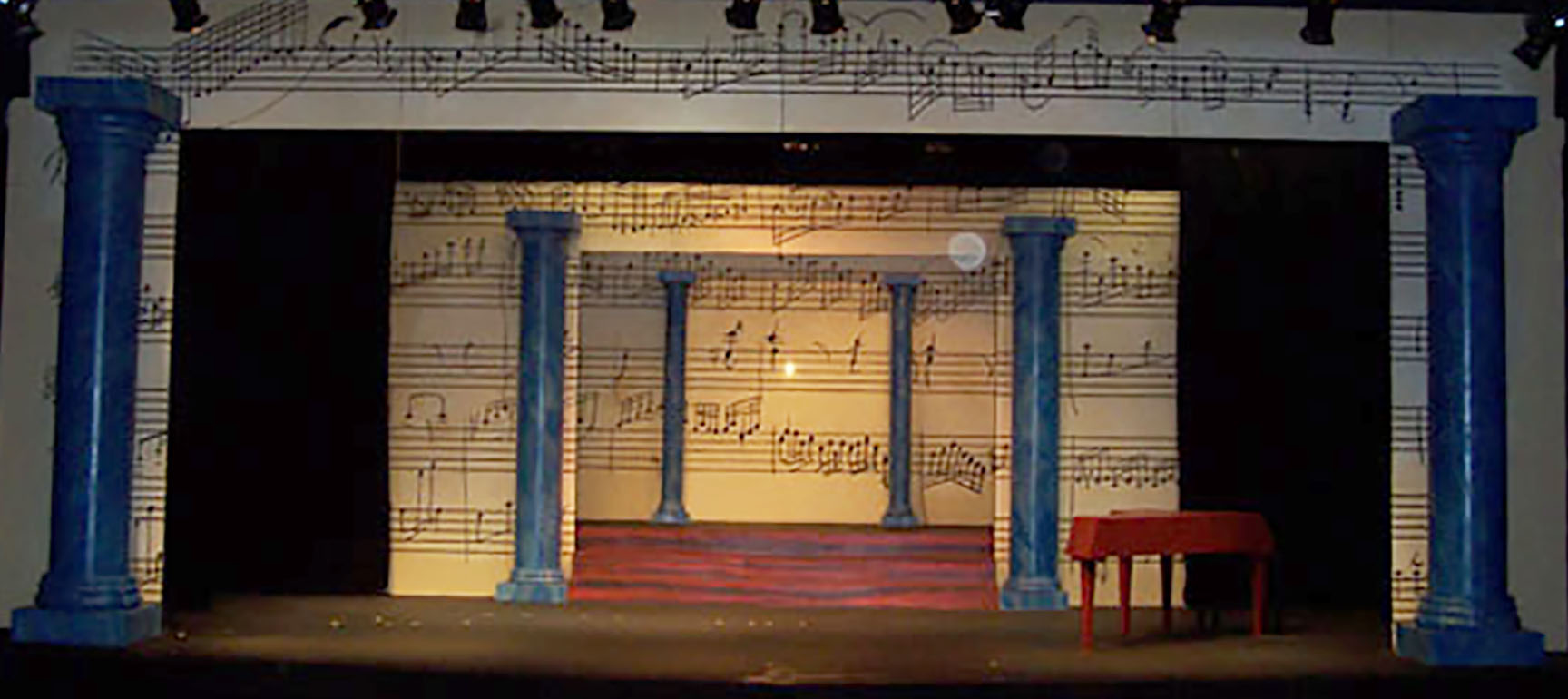
The set features a giant reproduction of a manuscript page in Mozart’s hand of the “Sonata for Violin and Piano in G Major,” flanked by blue marble columns. The piano is a reproduction of Mozart’s own pianoforte, fitted with a working keyboard that could be played live as well as playing recorded music sent from the sound booth, including pieces recorded by Noel Howland.

Posted in Directing, Set Design, Theatre | Tagged , , , , , | Leave a comment

Romeo and Juliet

Romeo and Juliet by William Shakespeare
Shane Lalani Center for the Arts, 2012
Directed by Gillian Swanson, designed by Marc Beaudin

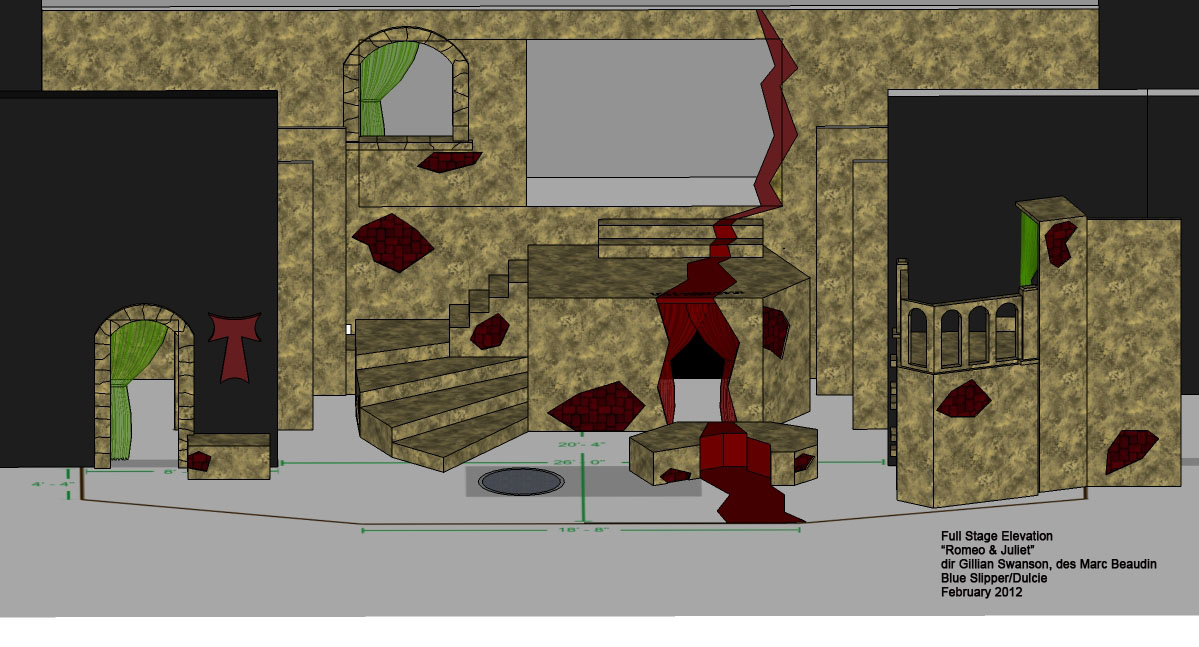
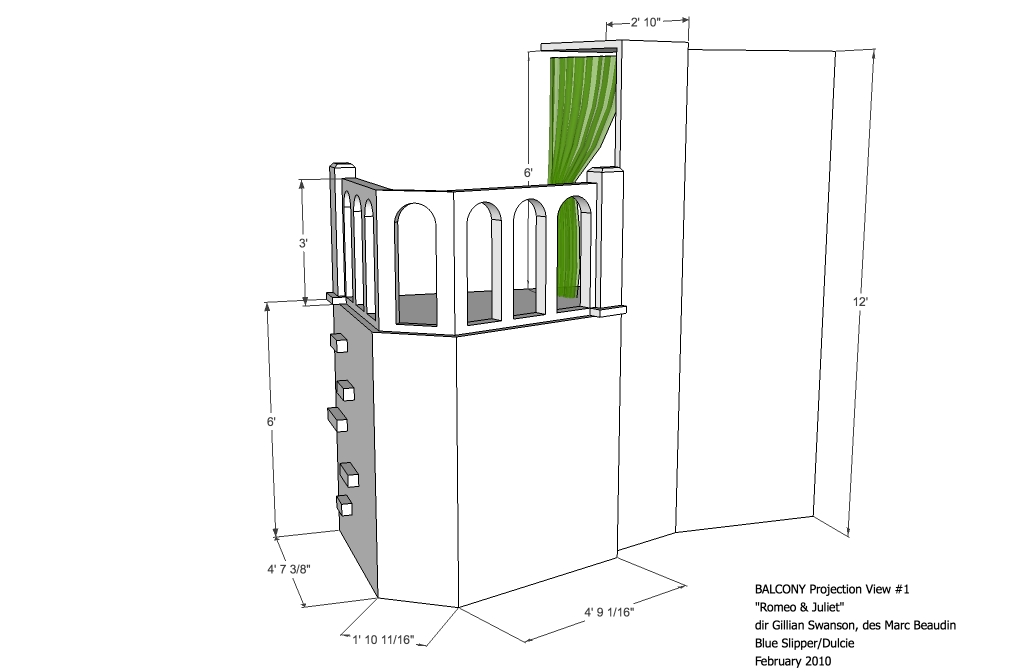
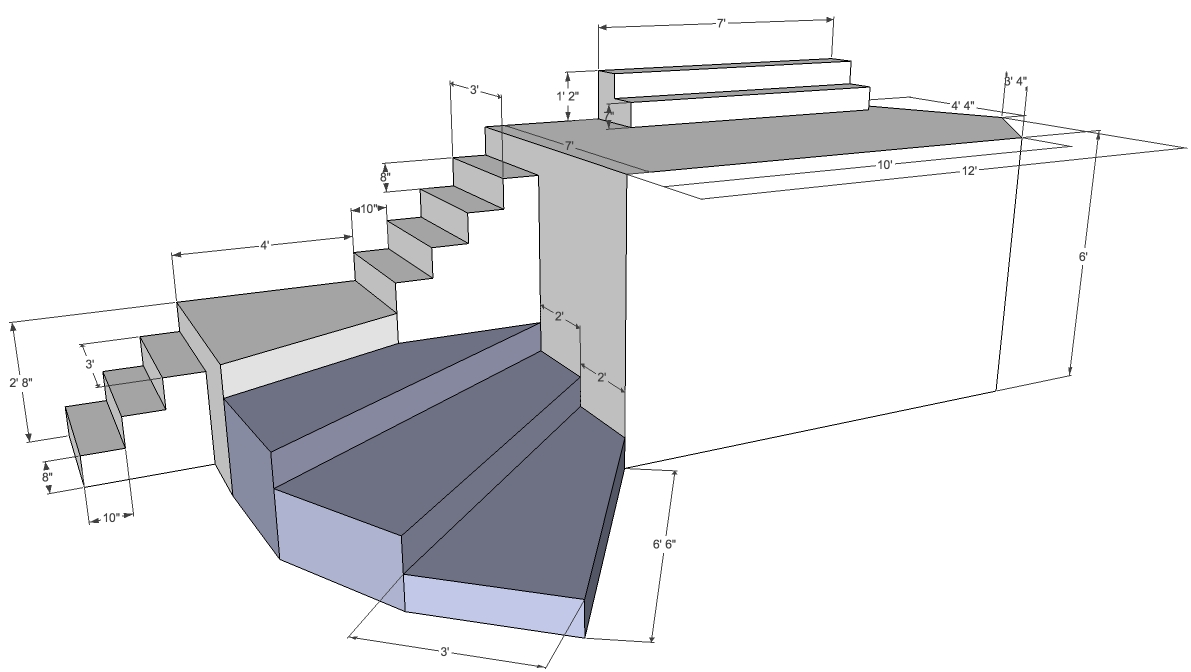
This was the first design I used SketchUp to create. It worked well for the nature of this set, especially since rather than building it myself as usual, I was able to hand off the designs to the carpenters at the Shane Center. I haven’t used SketchUp since, but I imagine I will someday. My idea with this design was that Verona is in a state of decay due to the strife between it’s leading families; the crack splitting the town in two drives home the idea. Unfortunately, I wasn’t able to complete the vision as the scenic painting was done by another who’s use of color and over-ornamentation bared no relation to my concept. My color plate elevation doesn’t show exactly what I had in mind due to my limited skill with SketchUp, but the general idea is a great Italian city that has crumbled into disrepair reflecting the diseased state of it’s social and political life.

Romeo and Juliet Elevation

Romeo and Juliet Balcony

Posted in Set Design, Theatre | Tagged , , | Leave a comment

The Women of Lockerbie

The Women of Lockerbie by Deborah Breevort
Bay City Players, 2009
Directed and designed by Marc Beaudin

“Beaudin’s beautifully understated direction makes this a must-see play. It speaks volumes about the human condition, and is performed brilliantly by its cast of seven.” –The Saginaw News

Director’s Note from the Program:

On the evening of December 21, 1988 (the winter solstice – the longest night of the year), terror rained down on the quiet town of Lockerbie, Scotland. Two-hundred seventy people, including 11 residents of Lockerbie, were killed when an explosive device destroyed Pan Am Flight 103 enroute from London’s Heathrow Airport to New York’s JFK.

This is now the 20th anniversary of that tragic attack. Unfortunately, in these ensuing years acts of terrorism have only evolved into nightmares of a much grander scale. These days, families and friends of victims live in every corner of the world, profess every religion and cultural background, represent every race and nationality.

This play is a journey with fictional characters in a very real situation: the attempt to find a way from grief to healing, from darkness to light. It takes place on the moss-covered hills near Lockerbie, but it is a testament to the suffering of all victims of all governments and ideologies. In the history of terrorism, guilt is found on both sides of the imaginary Us/Them divide. But just as the world is united by common crimes, it is also united by common misery, but more importantly, by common compassion.

It is my hope that by traveling with these characters on their journey, you will also find healing from whatever grief you may hold. That you will leave here tonight cleansed, uplifted, and filled with the light of a new day.

Such is the power of theatre. The ancient Greeks knew this. Their tragic structure is able to contain boundless pain and to prove cathartic. This is why our script utilizes their methods.

Traditionally on the winter solstice, people light candles to aid the return of the sun. It requires a leap of faith to believe that a small candle can bring light back to the world. Can lighting a candle really change anything? Can a play? Can a small act of kindness and understanding?

Absolutely. Such is the power of each one of us.

Design Concept:

The concept behind this set is that the moss-covered hills of Scotland serve two functions. First they reflect the moods and psychological states of the characters: desolate, dark, isolated and dead giving way to welcoming, hopeful and verdant with the rising of the sun and washing of the clothes. Second they are part of the healing process. In talking about the fog-covered hills, Bill says, “beauty was the last thing I expected to find in Lockerbie.” The idea was to make it such that the beauty and power of the set would contribute to the healing — healing that wouldn’t have happened if the play were set in town or in the church or in front of the warehouse. By using burlap-covered chicken wire, the fog could bleed directly from the hills. This, plus the sound of water flowing in the small stream and the moody, cold “moon” lighting, completed the emotional effect that the script requires. I am indebted to Jerry Dennis for assistance with this design and to Mary Swift who painted the mossy boulders.
Posted in Directing, Set Design, Theatre | Tagged , , , , , , , | 1 Comment