
The Women of Lockerbie by Deborah Breevort
Bay City Players, 2009
Directed and designed by Marc Beaudin
“Beaudin’s beautifully understated direction makes this a must-see play. It speaks volumes about the human condition, and is performed brilliantly by its cast of seven.” –The Saginaw News
Director’s Note from the Program:
On the evening of December 21, 1988 (the winter solstice – the longest night of the year), terror rained down on the quiet town of Lockerbie, Scotland. Two-hundred seventy people, including 11 residents of Lockerbie, were killed when an explosive device destroyed Pan Am Flight 103 enroute from London’s Heathrow Airport to New York’s JFK.
This is now the 20th anniversary of that tragic attack. Unfortunately, in these ensuing years acts of terrorism have only evolved into nightmares of a much grander scale. These days, families and friends of victims live in every corner of the world, profess every religion and cultural background, represent every race and nationality.
This play is a journey with fictional characters in a very real situation: the attempt to find a way from grief to healing, from darkness to light. It takes place on the moss-covered hills near Lockerbie, but it is a testament to the suffering of all victims of all governments and ideologies. In the history of terrorism, guilt is found on both sides of the imaginary Us/Them divide. But just as the world is united by common crimes, it is also united by common misery, but more importantly, by common compassion.
It is my hope that by traveling with these characters on their journey, you will also find healing from whatever grief you may hold. That you will leave here tonight cleansed, uplifted, and filled with the light of a new day.
Such is the power of theatre. The ancient Greeks knew this. Their tragic structure is able to contain boundless pain and to prove cathartic. This is why our script utilizes their methods.
Traditionally on the winter solstice, people light candles to aid the return of the sun. It requires a leap of faith to believe that a small candle can bring light back to the world. Can lighting a candle really change anything? Can a play? Can a small act of kindness and understanding?
Absolutely. Such is the power of each one of us.
Design Concept:
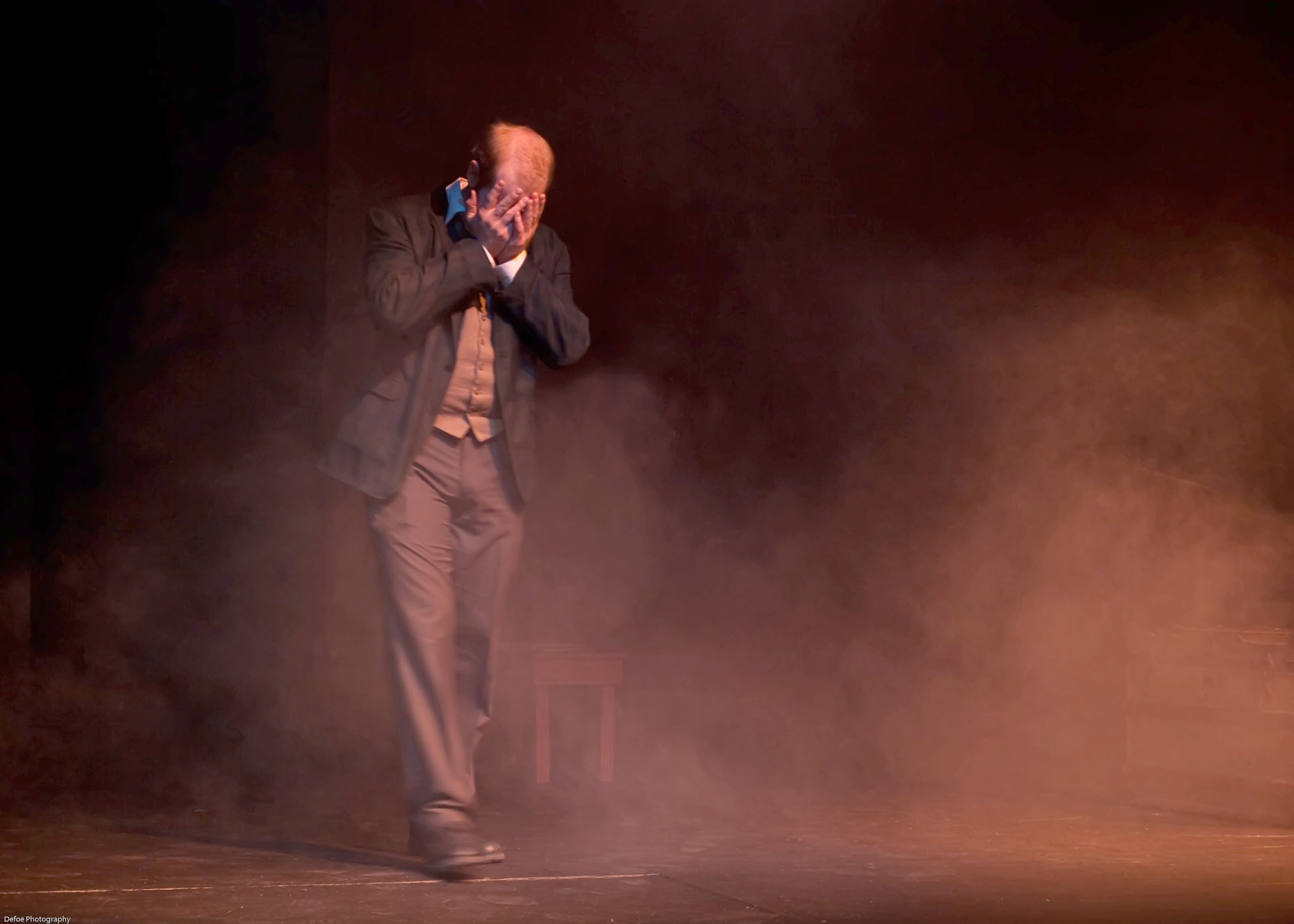
The concept behind this set is that the moss-covered hills of Scotland serve two functions. First they reflect the moods and psychological states of the characters: desolate, dark, isolated and dead giving way to welcoming, hopeful and verdant with the rising of the sun and washing of the clothes. Second they are part of the healing process. In talking about the fog-covered hills, Bill says, “beauty was the last thing I expected to find in Lockerbie.” The idea was to make it such that the beauty and power of the set would contribute to the healing — healing that wouldn’t have happened if the play were set in town or in the church or in front of the warehouse. By using burlap-covered chicken wire, the fog could bleed directly from the hills. This, plus the sound of water flowing in the small stream and the moody, cold “moon” lighting, completed the emotional effect that the script requires. I am indebted to Jerry Dennis for assistance with this design and to Mary Swift who painted the mossy boulders.


 Marc Beaudin