Introduction to Poet to Poet: Elk River 30 for 30 Poetry Prompt Collection
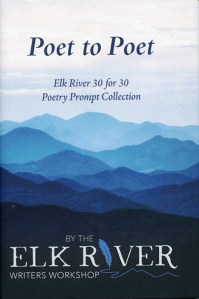 [Here’s the essay I was asked to write to introduce this book of poetry and poetry prompts by 30 acclaimed poets. The book is available here.]
The Poem is always there, waiting, in that cattail-speckled ditch at the roadside, that bird nest in the skeletal wintertime tree, that bit of conversation two barstools down, that half-remembered scrap of dream. The poet’s job is to be aware. To listen. To pay attention. The Poem wants to be heard, to be found and brought into our world. Whether or not that happens is up to us.
Sometimes the poem is insistent. It comes to us as an integral part of a Moment that’s impossible to miss. Years ago, sitting at a sidewalk table of my favorite coffeehouse, I noticed a daytime moon, some sparrows flying by, and then a car drove past. Without thinking or hesitating, I opened my journal and wrote:
What to Pray For
The moon cracks open
sparrows fall from its heart:
The world fills with song
But
one perfect bird will die tonight
under the wheels of someone
tuning their radio
Pray that it isn’t you
[from Life List: Poems]
I love this poem, partly because it reminds me to pay attention – to live in the Moment – but mostly because it feels like a gift: I didn’t write it, it was given to me. Who or what gave it, or how, or why, are questions I don’t ask. I just know that occasionally it happens, and I’m grateful. However, what to do with the millions of times that it doesn’t?
James Joyce teaches us, “Every moment of inspiration must be paid for in advance.” An artist friend of mine once told me, “I don’t wait around for inspiration to make my art. I make my art, and then it inspires me.” Both of these remind us of this vital truth: we have to do the work. We have to engage the world as poets, which means to be insatiably hungry with our awareness, our caring, our listening. And we have to pick up our pens and open our journals and let nothing stop the ink.
Easier said than done. But we’re not alone.
Because poetry is also a conversation. One we have with ourselves, but also with every poem we read, from that 500-year-old sonnet to the free flow of lines from a friend that just tumbled into our email’s inbox. We, through our writing, are in conversation with every poet and every poem we encounter. As Harry S. Tuttle says, “We’re all in this together, kid.”
A good writing prompt is like a radio dial – filtering out the static and tuning in the station of the Poem. It’s like a telescope, or sometimes a microscope – zooming in on the details that will reveal a new truth, which is to say, a very old Truth made personal. A good prompt is a defibrillator, it’s a set of jumper cables, it’s a shot of espresso (or tequila), it’s a wake-up call from the front desk of the motel of Life.
This book, then is a month’s worth of calls, a score-and-a-half of strong shots and electric jolts to help you get the ink flowing. These prompts are compiled from the first iteration of “Elk River 30/30: A National Poetry Month Writing Prompt Fundraiser.” The included poems aren’t necessarily examples of the prompts they accompany; but as with all poetry, you may find them to be prompts for you as well – further invitations to join the conversation.
The April fundraiser helps make our Elk River Writers Workshop possible. For a week every August, a diverse and eclectic group of writers gathers in Montana’s Paradise Valley in the shadow of the Absaroka Mountains soaring above the Yellowstone River, to take a deep dive into their craft, to practice the art of listening for the Poem (or Story), and to join each other’s search parties in finding the wild words waiting to be found. The Elk River 30/30 is writers helping writers who are helping writers become stronger writers, and now you have joined the effort. Thank you, and good writing.
~Marc Beaudin
Livingston, Montana


 Marc Beaudin